The early white men who came to Yoruba land met development, a well-ordered society, and high morality. They knew we surpassed them in these qualities. One of them therefore recommended that if they want to conquer us, the only thing they must do is to feed our inferiority complex.
Up till today, an average Nigerian still feels so inferior to the white man. Even in our government we talk about international best practices. We don’t develop anything at home except to send our officers abroad to learn how things are done there. So the white people changed our religion. They also changed our local languages. I watched on video the wife of Professor Wande Abimbola, the Iya Gbofa, saying that Nigerians should not be encouraged in their religion only when they see a white person practicing it. What she said is a product of our inferiority complex. Our government system is better, and it has produced results. It took care of everybody. It produced a sane society. So how did we get to this sorry state where what was once golden has become dull?
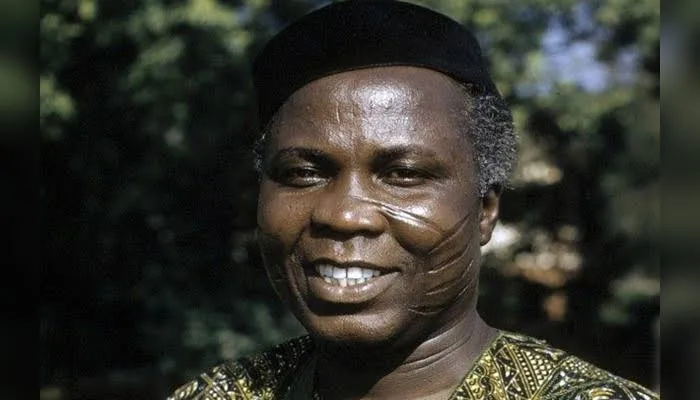
Chief Obafemi Awolowo, first premier of the defunct Western Region, was a politician any Nigerian should be proud of. Even the British colonizers gave testimonies to his brilliance and dexterity. Harold Smith, one of the British colonial officers, said even the political parties in Britain, which had been in existence for so long, were envious of the Action Group (AG)party of Awolowo. The organization was far beyond their expectations. So, too, was Dr. Nnamdi Azikiwe, the first president of independent Nigeria. He was a journalist par excellence. Awolowo feared the pen of Zik so much that he kept the formation of his Action Group a top secret because “if he (Zik) knew, he would kill the party at infancy.” Zik was a crowd puller and a great organizer. The British feared him and his press.
The combination of Awolowo and Nnamdi Azikiwe in the south of Nigeria was too much for the British colonizers, and they did everything to ensure power did not pass to any of them. Part of what they did was rig elections for the Northern Peoples Congress (NPC), the party in the north. Awolowo birthed politics of issues in the Western Region. He engaged the people intelligently, explained to them what he was going to do to make their lives better, and explained how he was going to raise money from the region to fund these programmes. The AG was well organized; members of the party were not to expect money from the party; rather, they were to contribute money to the party and fund the programmes of the party at the local level. “If there is a will,” he taught them, “there will be a way.” And they rallied behind their leader. In just five years of his leadership of the party and government, it was clear to everyone that Awolowo was the man to beat in the nation’s politics and government. He made the region a model of excellence in the nation. He engineered and led healthy competition among the three regions.
The way Awolowo got Yoruba to embrace education spoke to his dexterity. The high need for achievement of the Igbo and the way Zik mobilized the Igbo by it spoke also to the visionary competence of Nnamdi Azikiwe. Awolowo knew the Yoruba people are a laissez-faire people who enjoy their pleasure, and so in organizing his free education programme, he made it compulsory by law. A parent who will not send his ward to school risks going to jail. The Yoruba overcame their problem and embraced education. For Zik, when he announced education, the Igbo rushed at it, but the resources available were not enough to cope. Zik withdrew free education but organized every community to step up and contribute resources to send their wards to school. It was successful, and the Igbo got education that even the three-year gruesome civil war held back, but it was only for a brief time. In the nation we had two excellent leaders at the front.
What then happened that Nigeria became a nation where politics is thought of as an arena for the display of illiteracy and wanton foolishness? An arena where idiocy sits at the top. How did it come to be that politicians are no longer gunning and competing for the welfare of the people? How come that politics has become a means of making money? One of today’s politicians, a two-term governor in Ekiti State, Ayodele Fayose, while he was accusing Seyi Makinde, the sitting governor of Oyo State, of corruption, said on a TVC programme brazenly, “There is no man who goes through those offices (governor and president) who will not make money.” He was accusing Seyi Makinde on TVC, which is owned by President Bola Tinubu. His appearance on that television speaks volumes about who he was representing, as Seyi Makinde also is angling to be president. At the same time, Makinde is challenging Nyesom Wike, the president’s yeoman in the opposition People’s Democratic Party (PDP). The furore generated by that appearance is still generating heat in Oyo State and the nation.
Awolowo and Nnamdi Azikiwe gave themselves healthy competition, and their peoples benefited tremendously, but today only the politicians, their immediate families, and their cronies are enjoying the fruits of democracy, as the nation totters dangerously on the brink. Who played what role in the decadence that has happened must engage the attention of chroniclers of Nigeria’s political history and Nigerians. This is so that the trend may be halted and reversed. Otherwise the nation will grind to a halt.
We have to look at the Nigerian crisis and what role some of the lieutenants of these two giants played. Obafemi Awolowo was not as lucky as Nnamdi Azikiwe. Awolowo was disciplined and stern; he governed by policies and did not compromise. He ran on principles. But some of his disciples were not as disciplined as he was. They want things the easy way and are not as interested as he was in societal progress. The lieutenant of Awolowo that pioneered this was SLA Akintola, who succeeded Awolowo as premier of the old Western Region. Awolowo knew Akintola was not good as a leader, but I think he had to endure him. He came from a side of the Western Region, the Ogbomosho axis, where he had a good following. In one of his books, Awolowo recorded that Akintola was asked to prepare a paper on a chieftaincy issue in Ekiti province for use by the government. The paper was on Akintola’s table unattended to for two weeks. When Awolowo mentioned the issue to Rotimi Williams, the attorney general, he elected to do the assignment in place of Akintola, and he turned in the report in two days. Rotimi Williams was one of the able lieutenants of Awolowo. He had many of them because he recruited by merit.
Awolowo did not want to hand over power to Akintola, but for two years members of their political party, the AG, mounted pressure on Awolowo until the sage budged. The Yoruba are very diplomatic; they tell themselves that there is no case they cannot explain away, however bad. Akintola wanted power and popularity for himself. Service to the people of the Western Region was not his priority. Awolowo was disciplined in everything, especially women. When he was accused of pride, he answered that he had never said he was better than anybody but that when his contemporaries were jumping from party to party and from mistress to mistress, he stayed up at his study table studying the problems of Nigeria and finding solutions to them. How then can people who have been jumping from party to party beat him in any debate? Akintola was not so disciplined.
A friend came to my house sometime ago. He was going to the church burial ceremony of a woman who had died. To kill boredom, I asked to go with him. I was amazed to see that it was a Mrs. Akintola that was being buried. Amazed, I asked my friend why another Mrs. Akintola, because the only Mrs. Akintola we knew was Mrs. Faderera Akintola, who had died a long time ago. This Mrs. Akintola that was being buried, also had four children for Mr. Akintola, the premier. That was the day I knew that Mr. Akintola had other mistresses too. He was said to have met one of them on an official visit to Sir Ahmadu Bello, the premier of the Northern Region, whom he aligned with to undermine Awolowo. Akintola is the opposite of Awolowo in everything. Awolowo ruled by values, Akintola by deceit and ignorance.
Now compare the present politicians whose lifestyle is devoid of values. That is the reason for the decadence in the nation. The son of one of them recently left his father to join his main opponent in politics. His father said he does not coerce his children in matters of conscience. He lied; the attitude of his son is symptomatic of a disorder in his household. The man has four wives, and he wants to be president of Nigeria. The unruly and disgraceful public behaviour of the son of President Bola Tinubu also signifies some trouble in their home. It is only recently that the nation heard that the daughter who labelled herself “first daughter,” Mrs. Folashade Tinubu-Ojo, is a novel experience in the nation, and Seyi Tinubu is not from Oluremi Tinubu, the first lady.
The family is the first unit of society; it supplies personnel for government, and when it is disorganized, it will supply bad and immoral personnel to government. That is why governments fail. As for the president, and for almost all current top leaders in Nigeria, none can boast of keeping their family on a leash. Those who still keep one wife at home have several mistresses outside with many children out of wedlock. Awolowo was so proud to declare, “My wife is good, and she will tell you also that I’m a good husband.” Awolowo once rebuked an Akintola daughter for rudeness when he visited the Akintolas in their house. It is the family that first fails before you see government failure. Akintola could keep his daughter in his disagreement with his leader.
Akintola was everything a politician of conscience who is determined to serve his nation should not be. Politics can be clean and must be clean to give progress to the society. It is dirty because the men and women who flock into politics are dirty. This is why people say politics is dirty. Politics is not dirty; it is the men that play it that are dirty. So what were the politics of Akintola like, and what were the consequences of this, both for the Western Region, for the nation, and for Akintola himself? Akintola wanted to be popular. He was not happy that everywhere he went to campaign or talk, people shouted the slogan of Awo. He was jealous. He wanted them to call his name rather than that of Awolowo. He forgot that it took Awolowo time and good performance to earn that name. He wanted it without working for it, an odious character who wanted to be credited with a good name. It was his driver who leaked that secret ambition to Awolowo’s driver, who subsequently leaked it to his boss, Awolowo. According to reports, Akintola swore to his wife, Faderera Akintola, which his driver overheard, that “Awolowo’s name will go into oblivion in six months.”Akintola was also moved to disloyalty by his wife.
A professor emeritus of history and international relations at the University of Lagos, Olajide Osuntokun described Mrs. Faderera Akintola as “a huge woman with an equally huge ego.” She was always telling the husband, “You are either the premier or you are not.” When the home became too tough for the men, they begin to toe the lines of their wives. Women have been the brains behind most misdeeds of their politician husbands. You know the complex and dirty story of the spat between our Senate president, Godswill Akpabio, and a female member of the Senate, Natasha Akpoti, that got the female senator suspended for a controversial six months and led to many court cases on allegations bordering on sexual advances.
Wives of politicians don’t care from where their husbands get the huge cash they bring home in bulky “Ghana must go bags.” As long as the cash keeps flowing into the house and their lives of opulence go on, good performance and morality can go to hell. Foreign travel every now and then, children schooling abroad, police escort, daily feasting, etc., must continue. Wives of Nigerian politicians don’t inspire their husbands to higher ideals.
Akintola appealed to the greed of other lieutenants of Awolowo. Appointment was no longer based on merit but on political loyalty and the need to court support for Akintola. Akintola had an overbloated cabinet. Almost everybody became a minister. Do you see President Bola Tinubu in this? The president has a cabinet of about 54 people in a nation that he said needed reforms. Akintola and now Tinubu used appointments to maintain their popularity. As long as these leaders are assuaged, nothing else matters, whether the people are served or not.
A politician in Ibadan told me recently that he once served as a special assistant to “one of the former governors in Oyo State.” He continued, “I saw the governor only twice, and not one-on-one, but I was in a group of fifteen people.” He maintained the governors don’t need those special assistants and special advisers, but they are put there just to fulfill all righteousness. Waste, you call that. While the people suffer—these good-for-nothing lazy louts gulped all the money of that state. My contact told me he had an official car, salary, and perks. He collected a security allowance. This is why Hakeem Baba Ahmed, former Special Adviser to the Vice President on Economy, said he resigned. He said his appointment was only on paper and not in practice. He did not see President Bola Tinubu once before he left office.
Akintola would not mind reversing the good policies of Awolowo, which had borne good results and given good dividends of democracy, as long as that will paint Awolowo bad. For example, Awolowo created the Cocoa Marketing Board, which fixed prices of cocoa such that when there was a surplus, it was invested, and when there was a fall in prices, that surplus was used to cushion the fall such that farmers felt no loss. Akintola increased the price of cocoa to discredit Awolowo. But when prices fell, a policy reversal by Akintola put the finances of the region in trouble and also the finances of cocoa farmers.
It is said that the huge cabinet of Akintola, which gulped so much of the resources of the region and these cocoa price issues resulted in bad finances for the region. Within a short time Akintola got to power, every top public servant became corrupt. The top civil servants rallied to Akintola’s help; they approached Awolowo without letting Akintola know. Awolowo, in three nights of hard work, gave them a paper on how to reverse the ugly situation. They got Akintola to sign the paper as if he authored it, and the problem was solved.
Akintola prided himself on being a grassroots politician. He won’t campaign on issues but on abuses. In every part of the region, especially in the Ekiti province, where Awolowo’s free education was so successful that the people became the darling of Awolowo, they became the butt of cruel jokes and abuses of Akintola. He used their love for education to abuse them; he would twist their names and concoct cruel things from them to mock them. Awolowo for the first time in the history of internecine Yoruba wars, united the Yoruba, but Akintola, by his divisiveness, divided them again.
Akintola didn’t keep his divisive and tribal politics within the region; he extended it to the Igbo, who he made his enemies. He campaigned in the 1964 federal election that Yoruba must make a choice between freedom and more federal jobs and bondage and no federal jobs. He incited fear among the Yoruba. They must embrace his replacement of the NCNC, perceived to be the party of the Igbo, by his own political party, the Nigerian National Democratic Party (NNDP), which he formed after he broke away from the AG of Awolowo. While Awolowo did not participate at the federal level, Akintola alleged, the NCNC and Igbo had cornered all posts in the parastatals and other government offices locally and in embassies abroad. The Yoruba must therefore vote for his party in alliance with the NPC of the north.
Akintola had nothing on crucial issues of economy and development facing the Yoruba; he only appealed to their tribal instincts. He told them if they didn’t vote for him, ghosts would. Those ghosts are master riggers. How many such ghosts today populate our politics, writing election results well before the election, making sure that the electronic gadgets of INEC break down, and calling it glitches? How many such in the courts giving judgment against the wrong candidates?
Though he read law and practiced it before he came to politics, Akintola spoke and behaved as if he had never been to school just to identify with the ordinary people. This is what Nigerian politicians now call “grassroots” politics. Akintola began it. He derided those Yoruba who spoke the English language. He said the politics of America and Europe, which they read in books, cannot work in Nigeria. Politics in Nigeria: democracy in the country must not be like it is abroad; it must be aggressive, violent, extremely selfish, and divisive. The Yoruba must replace the Igbo everywhere. He accused the NCNC of appointing Yoruba to the dregs of offices “where there is no money but where they will only sit and speak English.”
So Akintola began the politics of “chop I chop,” at least in the western region. Today the seed he sowed has fully grown, and nobody goes into politics except if “there is something in it for him or her.” When they say a governor or president is good, it is because he is allowing them to steal. Nyesom Wike, the Minister for the Federal Capital Territory, declared this recently in a video that trended on social media. Clothed in his native dress, he danced beside a Rolls Royce. He clapped his two hands and said, “When a government does not favour you, that’s a government that is bad. The Tinubu government is good.” What that means in plain terms is that Tinubu’s government is good; it has favoured Nyesom Wike, and he has bought that N1.4 billion Royce Rolls to show for it. Wike has never worked or practiced the law that he read for one day; he has always been a public servant.
Recently, a former senator, Sekibo Thompson, invited Wike to see his sprawling mansion, which he had just built in Port-Hacourt in Rivers State, where Wike was a two-term governor and where he is having a running battle for supremacy with the sitting governor, Siminalayi Fubara, who was his political godson until selfish ambition, money, and control separated them. Sekibo’s house was estimated at about two billion naira by a friend in the building industry, and that in a state where hunger and violence because of poverty have become second nature to the people. Akintola built a big mansion in his hometown of Ogbomosho. The house is there today, abandoned and overgrown with weeds.
Today, when the Yoruba people remember Akintola, they do not do it with honour but as a man who wrecked all Awolowo began to do for them, a man who betrayed the people. When Akintola was killed in 1966, there was wild jubilation among the Yoruba. Akintola did not have enough time to document his own part of history, but one writer said if he had lived a little longer, he may have repented and reconciled with Awolowo. Awolowo was imprisoned partly due to Akintola’s intrigues against him, aided by the NPC-controlled federal government, which saw Akintola’s rebellion as an opportunity to remove a major obstacle to their dominance of the nation and to further their political interests in the region and dip the Quran in the Atlantic Ocean.
Akintola is remembered as a squandermaniac who wasted the region. They think of him as one who began the unwholesome practices and the dirt that dominate politics today in Nigeria. Akintola spoke from the two sides of his mouth. He gave promises he was not prepared to fulfill. He used the resources of the region to satisfy a few who could sustain him in power. He told lies without flinching. They remember him for immorality. Some who still love him, bad ones like him, try to rehabilitate his name and children, but it has not been possible. Yoruba cursed him and them. Awolowo is remembered everywhere and celebrated. As the Bible says, the memory of the just is blessed, but that of the wicked shall rot.
While Awolowo was in prison in Calabar, the January1966 coup happened. Nobody remembered to kill Awolowo in prison, but the soldiers remembered to visit Akintola in his premier’s lodge in Ibadan. He resisted the soldiers who knew the capacity of his gun. They allowed him to expend his bullets before they rained theirs on him. He was acclaimed to have juju, but his juju did not stand in the day of battle. He fell to a hail of hot lead from the soldiers’ guns. His friend and sidekick, Lekan Salami of Ibadan, one of the hordes he recruited to his government with monetary inducement, hauled him for a hurried, unattended, and secret burial in Ogbomoso the next day after he died. Politics can be issue-and moral-based if politicians will learn from the history of those who did it before them.
First Published in METRO
***********************
Tunde Akande is both a journalist and pastor. He earned a Master's degree in Mass Communication from the University of Lagos.


No comments:
Post a Comment