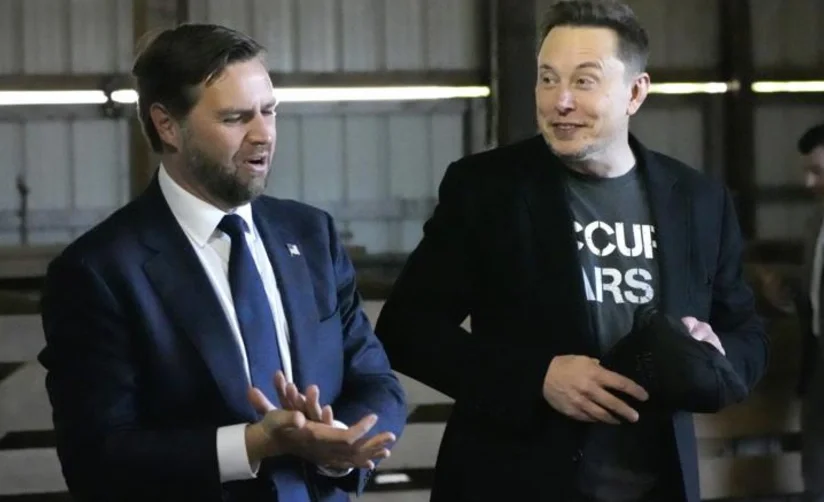
JD Vance and Elon Musk look like men from different planets. One rose from Appalachian poverty into the halls of political power, speaking the language of grievance, tradition, and national rebirth. The other built his myth in silicon, rockets, and spectacle, presenting himself as a prophet of the future who answers to no one. Yet if either wants a real future in the United States, they depend on each other more than they probably care to admit. Not by ideology, not by friendship, but by consequence. And that dependency is entirely of their own making.
Vance has tethered his political rise to a vision of America at war with its own elites. He speaks for people who feel abandoned by institutions, mocked by culture, and hollowed out by economic change. Musk, despite his outsider persona, is the embodiment of elite power: immense wealth, technological leverage, and direct influence over communication, transportation, and even national security. On paper, they should repel each other. In practice, they are locked in a mutually reinforcing loop.
Vance’s brand of politics needs figures like Musk. Populism requires villains, but it also requires trophies. It needs proof that power can be bent, that the mighty can be coerced into the tribe or at least into transactional alignment. Musk, with his restless need for relevance and conflict, provides exactly that. When he signals sympathy for populist anger, he lends Vance’s movement something it otherwise lacks: a sense of modernity. Rockets, AI, and social platforms make resentment feel futuristic instead of nostalgic.
But the dependence cuts the other way just as sharply. Musk’s businesses do not float above the nation-state. They are welded to it. Government contracts, regulatory tolerance, labor markets, infrastructure, and public legitimacy are not optional extras; they are oxygen. The fantasy of total independence collapses the moment policy shifts, subsidies vanish, or political hostility hardens into law. Musk needs a political climate that treats him as indispensable rather than suspect. Vance’s America offers that bargain, as long as Musk performs cultural loyalty.
Here is the trap they built together. Vance cannot fully turn against Musk without turning against the very idea that American greatness still flows through bold industrial ambition. Musk cannot fully reject Vance’s politics without alienating a base that increasingly views institutions, including corporations, through a lens of suspicion and revenge. Each has backed himself into a corner where opposition feels existential.
This is not a partnership of shared values. It is a pact of survival. Vance’s movement feeds on the perception that traditional America is being erased by unaccountable forces. Musk’s public persona feeds on the idea that he alone defies control. When these narratives collide, they do not cancel each other out; they fuse. The result is a volatile mix of grievance and power that thrives on constant tension. Neither man benefits from stability. Both benefit from permanent crisis.
Yet that same dynamic limits their futures. Vance cannot govern a complex nation on outrage alone. At some point, he must answer for results, not rhetoric. That means relying on precisely the kinds of technological and economic systems his movement loves to denounce. Musk, meanwhile, cannot play revolutionary forever. Empires that depend on public trust eventually need legitimacy, not just attention. The United States is not a neutral playground. It demands reciprocity.
Their shared weakness is arrogance. Both believe they can control the narrative indefinitely. Both underestimate the country’s capacity to turn on figures who overreach. America tolerates disruption, even celebrates it, but it punishes those who confuse influence with ownership. When voters or regulators decide someone has become too central, too loud, or too untouchable, the correction is swift.
If there is a future for either man in the United States, it lies in recognizing this interdependence honestly. Not as a culture war stunt or a temporary alliance, but as a sober acknowledgment that power here is relational. You do not dominate America alone. You negotiate with it. Vance and Musk may despise that truth, but they are bound by it. They built the cage themselves. Now they have to live inside it.
History suggests this story rarely ends cleanly. Mutual dependence curdles into blame, then fracture. When it does, neither populist fury nor technological bravado will offer shelter. The United States outlasts personalities by design. It absorbs them, reshapes them, or discards them. Vance and Musk are not exceptions. They are case studies unfolding in real time before an impatient, watchful public.


No comments:
Post a Comment