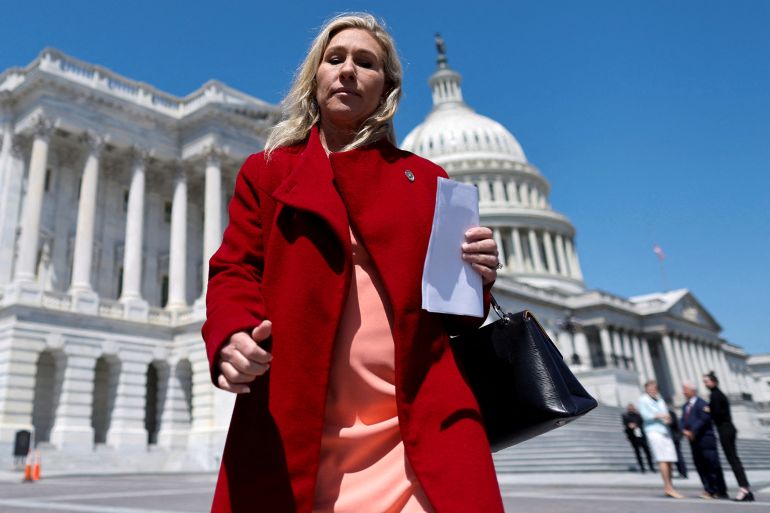
Don’t let Marjorie Taylor Greene’s latest attitude trick you. The sudden softening of tone, the selective outrage, the occasional performance of reasonableness are not evidence of growth. They are tactics. Greene did not wake up one morning having discovered nuance, empathy, or truth. She remains what she has consistently shown herself to be: a self-centered fascist, xenophobe, homophobic, Islamophobic bigot who has simply learned that volume control can be as effective as a bullhorn.
This is not a story of transformation. It is a story of rebranding. When the temperature changes, opportunists adjust their wardrobe. Greene’s latest posture is less about conscience and more about convenience. Extremism, when it threatens to isolate its own messengers, often dresses itself up as common sense. The ideas do not change; the delivery does. And Greene has always been acutely sensitive to attention, relevance, and power.
Her political career was never rooted in public service. It was built on provocation, grievance, and spectacle. She rose by attacking the vulnerable, mocking the dead, flirting with conspiracy, and framing cruelty as courage. Immigrants were not people but threats. Muslims were not citizens but suspicions. LGBTQ+ people were not neighbors but punchlines. Violence was winked at. Democracy was treated as optional. None of that disappears because the rhetoric briefly shifts from shouting to smirking.
What we are seeing now is not moderation but calibration. Greene has learned that outright extremism can carry costs when donors, leadership, or media access are at stake. So she experiments with plausibility. She borrows the language of populism without its responsibility, of patriotism without its pluralism, of concern without compassion. It is the same politics, stripped of its roughest edges, hoping fewer people notice the blade.
There is a familiar rhythm to this maneuver. History is full of demagogues who discover, mid-career, that survival requires appearing sane. They do not abandon their worldview; they disguise it. They speak of “questions” instead of accusations, “concerns” instead of slurs, “tradition” instead of exclusion. Greene’s recent tone fits neatly into that pattern. It is not an apology to those she has harmed. It is a strategy to keep harming with less resistance.
The danger is not that Greene has changed. The danger is that people want to believe she has. Fatigue sets in. The constant outrage exhausts audiences, and exhaustion breeds forgiveness without accountability. A calmer voice is mistaken for a better idea. But politics is not therapy, and optics are not ethics. The absence of screaming does not equal the presence of principle.
Greene’s record is clear and unambiguous. She has consistently aligned herself with authoritarian impulses, elevating loyalty over law and identity over equality. She has treated democratic institutions as obstacles rather than safeguards. She has framed diversity as decay and pluralism as weakness. These are not youthful mistakes or stray comments. They are the spine of her political identity.
Calling this out is not incivility; it is clarity. Words like fascist and bigot are not insults when they accurately describe behavior and belief. They are warnings. To pretend otherwise is to participate in the laundering of extremism, where repetition dulls memory and familiarity replaces scrutiny.
Free journalism does not exist to soothe power. It exists to interrogate it. And interrogation requires refusing the easy narrative of redemption when there has been no reckoning. Greene has not taken responsibility. She has not corrected the damage she has helped cause. She has not demonstrated solidarity with those she dehumanized. She has simply adjusted her tone and waited to see who will clap.
We should not. Democracy depends on memory. It depends on recognizing patterns, not performances. Marjorie Taylor Greene’s latest attitude is not a breakthrough; it is a mask. And masks, however polished, do not change the face beneath them.
The responsibility therefore falls on voters, journalists, and institutions to resist the seduction of lowered volume. Accountability is not canceled by composure. If anything, it becomes more necessary when extremism learns to whisper. We should judge politicians not by their latest clip but by their consistent values, alliances, and consequences. Greene’s consistency lies in exclusion and spectacle, not service. Until that changes in substance, not style, skepticism is the only rational response. Anything else rewards manipulation and invites repetition. The lesson here is simple and urgent: do not confuse quieter cruelty with kindness, or strategic restraint with growth. Democracy is eroded not only by those who shout lies, but by those who calmly expect us to forget them. And we must.


No comments:
Post a Comment