At the foundation of Nigeria’s perennial poverty is the kind of men and women we recruit into our leadership. The current system will never give us the correct leadership.
Nigerians must worry greatly at the leadership recruitment procedure given to them by the framers of the 1999 Constitution with the various amendments and the way the politicians and the courts have run the laws. Certainly that leadership recruitment has not helped the country’s democracy. In fact, to talk about democracy in Nigeria would be the greatest lie ever against democracy. This is not a legal examination; I’m not a lawyer but a pragmatic analysis of the system. Without appropriate and workable leadership recruitment, the nation can never have a working democracy.
The fact that we have not had good leadership since 1999, when the civilians regained democracy again from the military, shows that the recruitment procedure is not working. The fact that the government has not impacted the lives of Nigerians shows leadership failure. What we have in Nigeria are not leaders but dealers only interested in their pockets and their immediate families and cronies. Despite the false statistics the government has been spewing, an international accounting firm, PricewaterhouseCoopers (PwC), has come out and said that the year 2026 will not be rosy. It predicted more poverty for Nigerians. According to the firm, “approximately 33.1 million Nigerians will face food insecurity due to economic hardship and violence in northern food-producing regions. Food accounts for up to 70 percent of consumption in poorer households.” About three years ago, the National Bureau of Statistics (NBS) reported that 133 million Nigerians were in multidimensional poverty. This year that figure might move up to 141 million, according to PwC.
That the picture is very gloomy should not surprise Nigerians who have been watching the political economy of the nation. Only the government of President Bola Tinubu thinks otherwise; the average Nigerian knows that things have not been going well. Even the Minister of Finance, Wale Edun, and his principal, Bola Tinubu, gave conflicting figures on government revenue target figures for last year, 2025. It didn’t begin with President Tinubu; it was with us during former President Olusegun Obasanjo, and it was with us during the short-lived administration of the late Umaru Yar’Adua, and it was with the administration of Goodluck Jonathan; with the lackluster administration of Muhammadu Buhari, the man who must go down as the one who wrecked Nigeria the most since the return of democracy in 1999. And just as PwC has reported, it has been with us for the two years of President Bola Tinubu. We are going to elections in 2027, and if adequate care is not taken, Nigerians will vote on empty stomachs. The free food often distributed by politicians to attract votes will not be able to assuage the situation. Nigerians will collect their pittance and food, but they will not be fed because they have gone too deep into poverty for any politician to help from his or her pocket. One year to the election, they have started their game of electoral bribery. I teach electorates that they are the reason for bad government in Nigeria because they don’t vote according to their consciences but according to the bribes they receive from the politicians. One woman so close to me, who I have taught this principle, told me after she got a thousand naira from a politician who wants to be governor in Oyo state, “If I don’t take that money, there are hundreds who will take it. You just need to see the long queue. I’m even lucky to receive the money; there are many who will not. At least what I brought back will give a meal to my children and me.”
At the foundation of Nigeria’s perennial poverty is the kind of men and women we recruit into our leadership. The current system will never give us the correct leadership. And no matter how hard we work and pray, unless our leadership recruitment changes, we are not likely to be counted among the rich nations, no matter the great level of our natural and intellectual resources. Nigeria has one of the best stocks of intellectual powerhouses compared to any nation in the world. Nigeria’s oil deposits are the biggest in Africa, and every portion of Nigeria breathes with minerals needed in the world. Because of our poor leadership, foreign nationals steal these resources from us. They collude with our leaders and give guns to our poor men to kill themselves as bandits and insurgents, and while they do this, these foreigners cart away our minerals. Gold is not in Dubai, but Dubai has a large stock of gold stolen from Nigeria, from the north of the country where poverty has become second nature, from a people who need education but are denied because the leaders complain there are no resources. An up-and-coming leader in the political setup of Oyo State told me recently in a chat, “The kind of free education that Chief Obafemi Awolowo ran is no longer possible.” When he said that, I knew immediately why the nation can never make meaningful progress from the current crop of politicians, north and south. They steal all the money, but they have a poverty of ideas; they lack vision, they lack focus, and they lack the strength to propel Nigeria aggressively forward. Nothing will be possible for any man who says it is impossible. Another politician who has left politics because of the lack of conscience among his old colleagues told me that these colleagues told him they were not in politics because of the masses and God but because of themselves.
Another one told me the story of another very big fish in Nigeria’s politics who has earned himself the reputation of a career presidential contender, that at the approach of election, once this big fish steps out to Dubai, they know he will come back with millions of dollars. They don’t know how he does it, but they know he brings bags of dollars from Dubai. Maybe he is one of those who deals in gold and sells it in Dubai. During the last election, he reportedly gave $5 million to each state for the party's chairmanship election so that he would win all the states’ chairmanships preparatory to his being elected as the party’s presidential candidate. In that election cycle the politician told me that the $5 million that came to his state was exchanged at a local bureau de change in the ancient city and that his own share of the money was N125 million. He was to share that among his few helpers and pocket the rest. According to the politician, the $5 million was exchanged for about N8 billion naira, and all the money was shared before 6am, saying he drove home with his own share that early morning.
President Bola Tinubu employed a leadership recruitment pattern when he was governor of Lagos, which made him the only voice in the state up till now. He is now president, but nothing happens in Lagos except with his approval. He has planted all the governors that have ruled Lagos after him. His son Seyi Tinubu, about 40 years old, will be governor, all things being equal, in 2027. Who will dare him? He was recently conferred with the same title, one in Oyo, reputed to be the political capital of the Yoruba people, and the other in Lagos State, where his father is the kingmaker. In Oyo, by the Alafin of Oyo, he received the title of Okanlomo of Yoruba land. And in Lagos he was given the Okanlomo of Lagos Eyo. Okanlomo means a cherished child, a distinguished one that towers above all others. Nigerians who went to watch a Nigerian match in Morroco, reported seeing in the hotel where the national team, the Green Eagles, lodged, posters of Seyi Tinubu everywhere. It is not that they want him to be the Okanlomo of Morocco, but they are signifying to the world beyond Nigeria that he is the next governor of Lagos State, the most complex of all states in Nigeria, where every family in Nigeria has at least one representative. There was nothing about Seyi Tinubu that prepared him for that very big assignment except that his father, President Bola Tinubu, had decided that he must be. Leadership recruitment gone sour is sure to produce low performance. Who cares? If Seyi Tinubu becomes the governor of Lagos State, then Nigeria will welcome Tinubu and his family as a monarch.
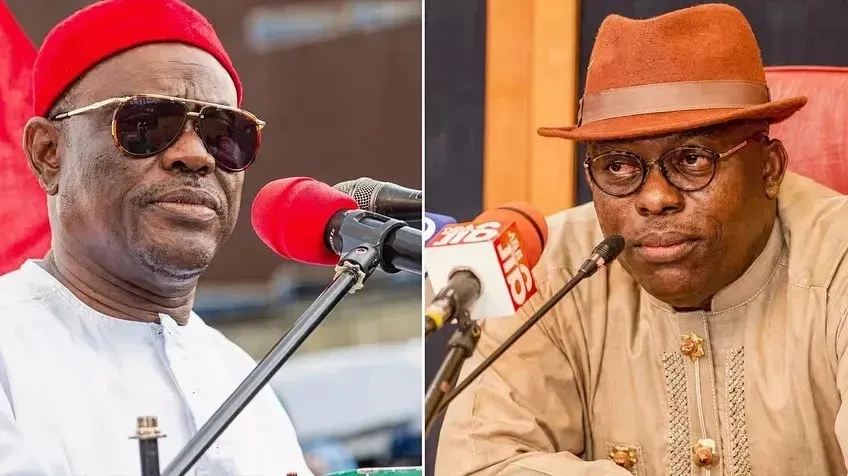
The ongoing tango between the former Rivers State governor and the current Minister of the Federal Capital Territory, Nyesom Wike, and his godson, Siminalayi Fubara, is a great testimony to how bad Nigeria’s leadership recruitment is and why it must be changed for there to be meaningful progress in Nigeria, one that favours the poor, whose governance must be for them. Fubara was the Accountant General in Wike’s government. He is from a minority ethnicity in Rivers State. His ethnicity is so small in population that he cannot win an election if all his ethnicity votes for him. He was also a civil servant. Those qualify him for the post of governor above more qualified people. You don’t become an accountant general to a governor in Nigeria unless you are trustworthy—trustworthy to help the governor to cook the books and siphon money. Oil money flows freely in Rivers State. It is a state that flows with milk and honey because it has a big deposit of oil under its soil. The humongous amount of money in Rivers State made Wike about the most powerful governor in Nigeria. Wike fought tooth and nail to wrest power of Rivers State from his predecessor, Rotimi Amaechi. Nyesom Wike never worked one day with his law degree, but he won the election with much money. As governor with huge financial resources in his state, he could help other less endowed governors in other states with money to win their elections. Ayo Fayose, the former governor of Ekiti, benefited from the largesse of Nyesom Wike and became his most ardent supporter. For Fubara, his weakness endeared him to Wike; whatever his disqualification is, it is a qualification in Wike’s sight. The weaker he is, the lesser will be the trouble he will be capable of giving Wike as the political godfather. With the huge dollar resources of Wike, courtesy of his being the governor of the oil-rich state, Wike nurses the ambition of ruling Nigeria. Who else is more qualified? He is the richest, and he has fought and won great battles against Rotimi Amaechi, another former Rivers governor. Rivers State is the most dreaded of all states in election rigging and election violence. Wike had won his election in a state noted for electoral violence and where Rotimi Amaechi himself had once admitted that all a person needs to win an election is to have the figures written for him even before a single vote is cast. Nyesom Wike won in a tense atmosphere against the candidate of sitting governor Rotimi Amaechi. It was a battle of titans, a battle of great violence, a battle of cash, a battle of guns, and a battle of cultists, but Nyesom Wike won. He is an all-rounder.
As for his presidential ambition, those who underrated Wike, like this writer, were soon disappointed; Wike had what it required to win the most complex election in Nigeria: money. Wike was soon funding the election of governors in the north, where the population is great, and soon governors in the north were trailing him. He is a great opposition to Atiku Abubakar, a veteran in presidential election contests and a man with a large war chest, large enough to put fear in any opponent. But not Nyesom Wike. Atiku deployed his tactics and defeated Wike in their party’s primary. Atiku controlled the party structures; he ensured that the north, from where he hails, had all the major and important party offices. Wike and others couldn’t persuade him to back down, and consequently a group of five PDP governors headed by Wike was formed to work against Atiku Abubakar. In the end, Atiku lost the presidency to Tinubu, who formed a government at the centre and took Wike along as minister of the Federal Capital, a minister like a governor because the Constitution treated the Federal Capital as a state. The appointment exposed Wike to more money at the federal level.
With Wike and the five governors of PDP, it was only a matter of time before PDP collapsed for not doing the bidding of Wike. Seyi Makinde, Governor of Oyo State, said recently that he was taken aback when Wike, in a meeting with the G5 governors of the PDP who helped Tinubu to power, told the president that he would help him hold the PDP, the main opposition party, down until 2027. That amazed Seyi Makinde because, as he alleged, that was not in their plan. Meanwhile, Seyi Makinde has also developed ambitions to be president in 2027. Once united by friendship to undo Atiku, Wike and Makinde are now enemies intent on tearing themselves and their party apart. The PDP has virtually fallen apart; Makinde was reported as defecting to ADC, a new coalition of opponents put together to undo the second-term bid of Bola Tinubu. In the interim, Fubara developed the idea of being his own man. After the declaration of a state of emergency in Rivers State, Governor Fubara was suspended from office by President Bola Tinubu for six months, together with the legislature and the deputy governor. Thereafter Fubara ate the humble pie and capitulated to Wike after which he was restored to office at the end of those six months. But a restored Fubara is at loggerheads with his political godfather. He has defected to APC, where all the members of the House of Assembly of the state have also defected. Siminalayi Fubara is claiming superiority to Wike, who now seems to be losing favour with President Tinubu. The state legislature has commenced impeachment proceedings against Governor Fubara, but as the impeachment proceeds, Minister of Works, David Umahi, Governor of Imo State, Hope Uzodinma, and National Security Adviser Nuhu Ribadu visited Siminalayi Fubara in PortHacourt, the capital of Rivers State. In Abuja, the Secretary of APC, Ajibola Bashiru, who has been exchanging verbal swipes with Nyesom Wike along with other party leaders and members, staged a protest calling on President Bola Tinubu to remove Wike if Wike will not resign from office. They let Wike know he was not a member of their party, APC. They accuse him of attempting to change the party structure, whereby the governor of a state where the APC is in government is automatically the leader of the party in the state. Wike does not want Fubara to be the leader of the APC, from where he and the legislators have defected. With Fubara as party leader, it would mark the end of Wike’s grip on the political machinery in the state.
Only imbeciles will not see the two hands of President Bola Tinubu in the visits of his key minister, David Umahi, his security adviser, Nuhu Ribadu, and a major governor in the east, Hope Uzodinma, to Fubara at a time when the legislature has begun impeachment proceedings against him. And only fools will not see Wike as being on his way out of the Tinubu government. President Bola Tinubu is more a politician than a statesman. So also are Wike and other contenders. That is what our leadership recruitment has been giving us since 1999. We have leaders who are more concerned with their sustenance than the continuity and progress of the nation. Nyesom Wike said it pointedly: “We cannot allow Fubara for a second term; we will be dead politically if we do.” Wike is more interested in himself than bothered that since he left office as the governor of the state and his godson stepped in, the state has not had good government. Wike has virtually relocated to PortHacourt, which means that his job in Abuja is suffering. What is the next move of President Bola Tinubu? If he removes Wike and retains Fubara, the state could catch fire. Nothing is beyond our politicians; somebody I contacted volunteered. But while the nation is suffering, the politicians are taking care of their narrow interests and that of their families, flying abroad for medical checks. President Bola Ahmed Tinubu virtually runs the nation from France, where he goes at the slightest opportunity. This is nothing but the result of our sloppy political recruitment system. It does not need a repair but a total overhaul. For those who care, nothing but a revolution will clean this Augean stable. Both the system and the people running the system are wrong and must be replaced.
First Published in METRO
***********************
Tunde Akande is both a journalist and pastor. He earned a Master's degree in Mass Communication from the University of Lagos.


No comments:
Post a Comment