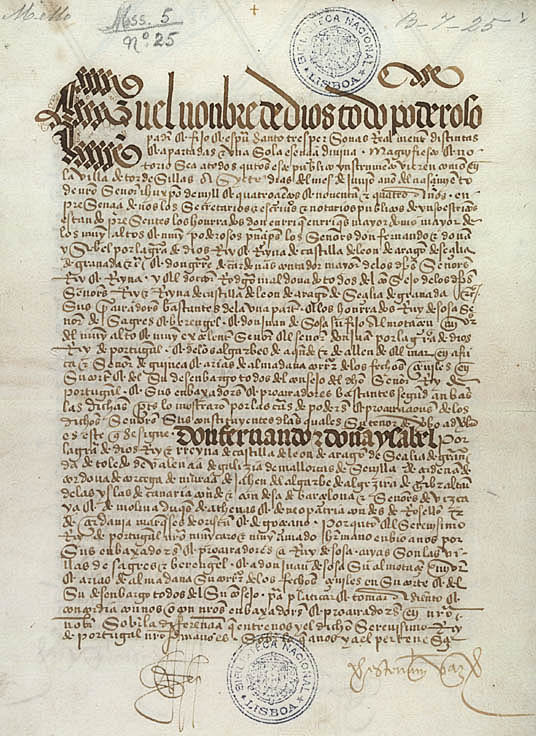
7 June 1494 remains one of the most remarkable and controversial dates in world history. On that day, representatives of Spain and Portugal signed the Treaty of Tordesillas, an agreement that attempted to divide vast portions of the globe between two European powers. By drawing an imaginary line approximately 370 leagues west of the Cape Verde Islands, the treaty granted Spain rights to lands west of the line and Portugal rights to lands east of it.
At first glance, the agreement may seem like a practical diplomatic solution to a growing rivalry. Yet, viewed through a modern lens, it appears astonishingly arrogant. Two monarchies, possessing limited knowledge of the wider world, effectively claimed ownership over territories inhabited by millions of people whom they had never met and whose societies they barely understood.
The Treaty of Tordesillas stands as both a masterpiece of diplomacy and a symbol of European imperial ambition. Its legacy continues to shape the modern world more than five centuries later.
The treaty emerged from a period of extraordinary exploration. In 1492, the Italian navigator Christopher Columbus, sailing under the Spanish Crown, reached lands across the Atlantic that Europeans had not previously incorporated into their geographical understanding. Although Columbus believed he had found a route to Asia, his voyages opened the door to extensive European expansion.
Portugal, meanwhile, had spent decades investing in maritime exploration along the African coast. Under the influence of figures such as Prince Henry the Navigator, Portuguese sailors had steadily pushed further south, seeking trade routes to Asia and access to valuable commodities.
The sudden possibility of overseas empires created a serious problem. Spain and Portugal were emerging maritime powers, both eager to secure wealth, prestige, and strategic advantage. Without a formal agreement, conflict seemed inevitable.
The solution was diplomatic rather than military. Negotiations led to the Treaty of Tordesillas, which sought to prevent war by establishing a clear boundary between the spheres of influence of the two kingdoms.
Perhaps the most striking aspect of the treaty is its underlying assumption: that European rulers possessed the authority to divide lands they neither controlled nor fully understood.
No representatives from the Americas, Africa, or Asia were present during the negotiations. Indigenous peoples had no voice in determining their own futures. Their existence was largely ignored in a document that would profoundly affect their descendants for centuries.
From a modern perspective, this attitude appears deeply flawed. The treaty reflected a worldview in which powerful European states regarded non-European territories as prizes to be allocated rather than societies with their own histories, cultures, and rights.
Yet it would be simplistic to judge the treaty solely through contemporary standards. The late fifteenth century operated according to very different assumptions about sovereignty, religion, and international law. European monarchs believed that Christian authority, royal legitimacy, and papal endorsement provided a sufficient basis for territorial claims.
Understanding this context does not excuse the consequences, but it helps explain how such an agreement could be considered reasonable by those who signed it.
The treaty played a pivotal role in shaping the development of overseas empires. Spain expanded across much of the Americas, eventually establishing control over enormous territories stretching from present-day Mexico to South America. Vast quantities of silver and gold flowed into Europe, transforming the Spanish monarchy into one of the dominant powers of the sixteenth century.
Portugal focused on Africa, Asia, and eventually Brazil. The treaty's boundary proved particularly significant when Portuguese explorers encountered the eastern coast of South America. Because part of modern Brazil fell within Portugal's designated sphere, the country developed as a Portuguese-speaking society rather than a Spanish-speaking one.
This outcome demonstrates the extraordinary influence of a line drawn on a map thousands of miles away. Modern Brazil, home to more than 200 million people, owes much of its linguistic and cultural identity to decisions made in Tordesillas in 1494.
The treaty therefore did not merely allocate territory; it helped shape the cultural geography of entire continents.
While criticism of the treaty is entirely justified, it is also worth recognising its diplomatic significance. Europe in the fifteenth century was no stranger to warfare. Territorial disputes frequently escalated into prolonged conflicts. In this context, the Treaty of Tordesillas represented an attempt to manage international competition through negotiation rather than violence.
The agreement acknowledged that competing powers required mechanisms to regulate their ambitions. In a sense, it foreshadowed later developments in international diplomacy and treaty-making.
Of course, the treaty's effectiveness was limited. Other European powers, including England, France, and the Netherlands, eventually rejected the notion that Spain and Portugal possessed exclusive rights to overseas territories. As their maritime capabilities expanded, they challenged Iberian dominance and established empires of their own.
Nevertheless, the treaty remains an early example of states attempting to solve geopolitical disputes through formal agreement.
The immediate beneficiaries of the treaty were Spain and Portugal. They gained legal and political justification for exploration and conquest, while reducing the likelihood of direct conflict between themselves.
The greatest losers were undoubtedly the indigenous populations of the Americas and other regions affected by European expansion. The centuries following the treaty witnessed conquest, displacement, forced labour, cultural destruction, and devastating epidemics.
Many indigenous societies experienced profound disruption as European empires expanded. Entire civilisations were transformed or destroyed. The wealth generated by colonial systems often came at an immense human cost.
At the same time, the treaty indirectly contributed to the creation of the interconnected global world we know today. Trade networks expanded across oceans. New crops, animals, technologies, and ideas moved between continents. The process was often unequal and frequently brutal, but it fundamentally reshaped human history.
The modern global economy, with its extensive international connections, owes something to the age of exploration that the treaty helped facilitate.
More than five hundred years after its signing, the Treaty of Tordesillas remains a fascinating historical paradox. It was an agreement designed to prevent conflict, yet it facilitated centuries of imperial expansion. It demonstrated diplomatic sophistication, yet rested upon assumptions of extraordinary entitlement. It sought order, yet contributed to immense upheaval.
Most importantly, it reminds us that maps are never merely geographical tools. They are expressions of power. The line drawn west of the Cape Verde Islands was not simply a cartographic exercise; it was a declaration about who possessed the authority to shape the future.
History has shown that no nation can permanently divide the world according to its own wishes. Yet the Treaty of Tordesillas illustrates how profoundly political decisions can influence generations to come.
On 7 June 1494, two kingdoms attempted to divide the unknown world. In doing so, they helped create the modern one.


No comments:
Post a Comment