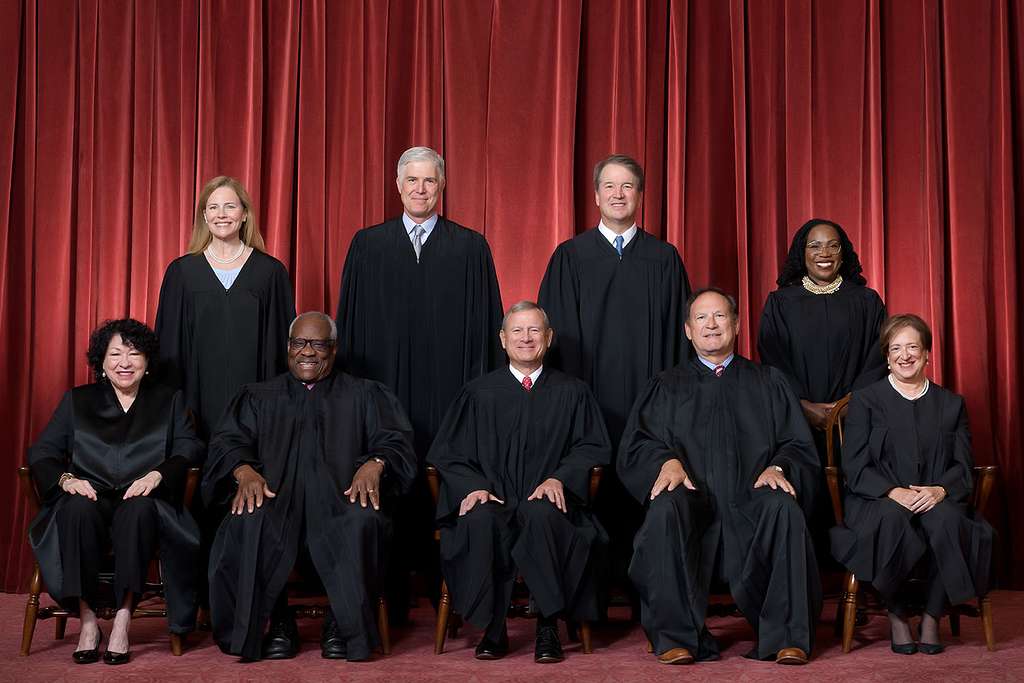
How many more pro-Trump decisions can the Supreme Court take before it loses whatever credibility it still holds in American public life? That question is no longer whispered by law professors or muttered by activists on social media. It is now asked openly at dinner tables, in newsrooms, and even in courtrooms themselves, where judges increasingly feel the need to explain that they are not politicians in black robes. The problem is not that the Court sometimes rules in ways that benefit Donald Trump. The problem is that it keeps doing so in ways that appear calculated, selective, and structurally protective of one man and one movement.
The Supreme Court survives on a fragile illusion: that it stands above politics. It has no army, no power of the purse, and no democratic mandate. Its authority rests almost entirely on public acceptance of its legitimacy. Once that acceptance erodes, the Court becomes just another political actor, issuing commands that large parts of the country feel no moral obligation to respect. History shows that courts without legitimacy eventually find their rulings ignored, circumvented, or openly defied.
What has changed in recent years is not merely the ideological composition of the Court, but the brazenness of its interventions. Longstanding norms are brushed aside with alarming ease. Precedents that once seemed settled are suddenly described as flawed, outdated, or wrongly reasoned, while others are treated as sacred, untouchable truths. The pattern is hard to miss. When Trump’s interests are at stake, the Court moves quickly, creatively, and generously. When democratic safeguards or institutional accountability are on the line, restraint magically disappears.
Supporters of the Court’s current majority insist this is all coincidence, that conservative jurisprudence naturally aligns with Trump’s positions. That explanation grows thinner with every ruling. Legal philosophy does not require contortions that consistently shield one political figure from consequences faced by everyone else. Nor does originalism demand selective urgency, where some cases are rushed through emergency dockets while others languish for years.
The damage goes beyond Trump himself. Each such decision sends a clear message: power now determines justice more than principle. That message corrodes faith not only in the Court, but in the legal system as a whole. Why should ordinary citizens believe the law applies equally when the most powerful man in the country appears to operate under a different set of rules? Cynicism spreads faster than any constitutional theory can contain it.
There is also a deeper institutional danger. By aligning itself so visibly with one political camp, the Court invites retaliation. Court expansion, jurisdiction stripping, term limits, and other once unthinkable reforms move from fringe ideas to mainstream debate. The justices may dismiss these discussions as political noise, but they are in fact warning signals. Institutions that refuse to self-correct eventually get corrected by force.
Ironically, the Court’s majority may believe it is securing conservative dominance for a generation. In reality, it is gambling with the Court’s long-term survival as a respected arbiter. Victories achieved through perceived bias are unstable. They provoke backlash, mobilize opposition, and delegitimize future rulings, even those grounded in sound reasoning.
The Supreme Court does not need to be liberal or conservative to regain credibility. It needs to be believable. That means consistent standards, transparent reasoning, and a visible willingness to rule against allies when the law demands it. It means understanding that restraint is not weakness, and that legitimacy, once lost, is almost impossible to restore.
So how many more pro-Trump decisions can the Court take before losing any credibility? The uncomfortable answer is that it may have already crossed that line for millions of Americans. The real question now is not whether the Court will lose credibility, but whether it recognizes the danger in time to change course. If it does not, the black robes may remain, but the authority they once symbolized will continue to fade.
And that fading matters. Courts function on consent, not coercion. When citizens stop believing that justice is blind, they start treating rulings as partisan suggestions rather than binding decisions. That is how constitutional systems decay, not with tanks in the streets, but with shrugs and workarounds. The Supreme Court still has time to step back from the edge, but time is not infinite. Every decision that looks like favoritism accelerates the slide, turning skepticism into settled belief, and belief into indifference, which is the most dangerous verdict any democracy can render. Once indifference sets in, even correct rulings sound hollow, and the Court’s voice becomes just another opinion in the noise. Alone.


No comments:
Post a Comment