Like me, you may have read some books on politics, diagnosed the problems, and come up with your own theories on how to fix Nigeria’s politics. But have you experienced it in practical terms?
You may have, but I had not until very recently. I detest our nation’s politics and stay away from the fray. I only discussed it. But I decided to observe it from the actions of practitioners. I took advantage of the current lifting of the ban on political campaigning to watch politicians at close quarters.
Furthermore, my community is grappling with an issue previously experienced by other communities, but which I am now confronting for the first time. The ugly Nigerian, who made life difficult for ordinary people, crept into our community transformer while everybody slept, climbed the very tall electric poles and cut the transformer cables.
Their job was easy. There was no current flowing through those cables and they were cut off easily. They carted the cables away. Our leaders had just returned from the Disco that controls our community to plead that the fuse of the transformer which they had removed because as they alleged we were not up to date in the settlement of our electricity bill be put back. They were successful and we were plluged back.
But two days later, cable thieves struck a deadly blow and we went back into pitch darkness. Our leaders went back to see what could be done. We need to raise 3 million naira to connect another cable back. That amount was negotiated down to N2.2 million. Even at that, our community could still not afford it. We are a very poor community. We are the ones that politicians tell lies to then use and dump.
What was a calamity became for me an opportunity to satisfy my new quest to watch politicians do their business in Nigeria. At least I will be at a vantage position to watch and learn. I joined the elders and suggested to them that we seek help from politicians jostling for offices. Ordinarily, replacing cables, I told this set of mostly illiterate leaders, is not the job of electricity consumers. Once we pay our tariffs and pay out taxes, it is the job of the Disco to fix our cables.
I told them that politicians could help us by making noise about the stolen cables and the resultant darkness that had descended on our area. If our representatives make a little noise in the House, our Disco will immediately rise to the issue. If we don’t do that we may just be in darkness for many years. Another way is to suggest the politicians buy the cables for us.
We set to work and suggested two prominent politicians, one, a gubernatorial candidate and the other a senatorial candidate who is said to be a moneybag. We drafted our letters and planned to deliver the letters to each one of them. I advised that we deliver the letters personally to the politicians. Some who have experience with politicians said we must hire a vehicle to convey many people to the house of the politicians because they like crowds.
The real experience of Nigerian politics for me began from this stage; behind my back some people who probably heard we were making plans to seek the politicians for help began to visit them with fabricated messages. They claimed they have been sent by these politicians to beg the community not to allow anybody but themselves to do the job. Their pleadings were so fervent that you would think once we got to them the job would commence immediately. After a while I began to discern their lies but those elders did not.
These jobbers probably have a distant connection with the politicians but not one that is able to make any impression or get anything done. In the evening while we were at a small political rally for our ward, our chairman had a call that he must get home quickly because a jobber was bringing the amount we had requested to him in cash. The chairman told me, and we arranged that he must be on the way immediately while an old political warhorse stayed behind to continue with our chase of a member of the House of Representatives who was to address the rally.
Another footman had promised he had arranged for us to see this Honourable. But when the man came and our letter was handed to him, his reaction showed vividly that he had never been briefed that we were coming. He immediately returned the letter to the ward leader who gave it to him. The Rep only came with one million naira meant for all in attendance that night to share. The politicians in all their hierarchies are the most disorganized people. That is obviously why our government is disorganized.
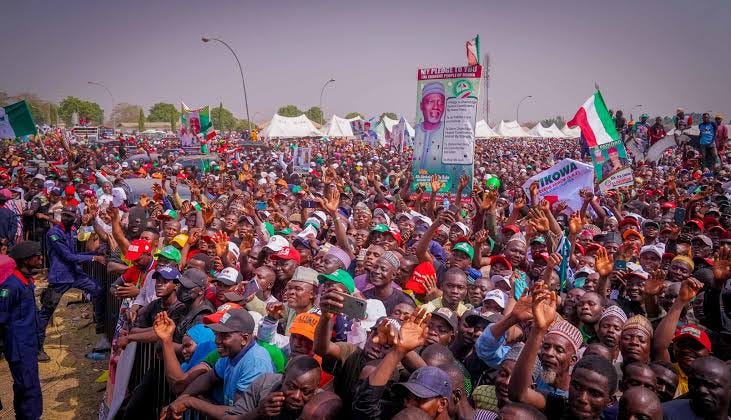
Over ninety percent of attendees for that rally were women. They were very poor. I had seen a particular one among them in the street many times looking to me to give her some money. On a few occasions when I had money I had given her some. On this particular occasion, when she spotted me in the place I sat beside the bigwigs she came to specially greet me. I gave her five hundred naira and she was so happy that she introduced her son, a member of the party ward leadership to me.
I asked our chairman why women outnumbered the men in attendance. He told me “women had more time available to them than men. The men by now, even though it was about 6 pm must be at their places of work but the women even if they engage in petty trading, don’t mind packing up their wares to attend a rally. At another political rally, a meeting of 12 wards of a popular political party, women attendance was up to ninety percent.
They danced to the local musicians who sang the praises of the contestants, they danced waving their handkerchiefs in the air, they created their own music and danced to it. They sang to thank their husbands who allowed them to participate in politics. They called themselves ‘Obinrin Rere’ (Good Women). They must have borrowed that from the “Good Women Choir” of the Christ Apostolic Church, a popular evangelical church in Nigeria.
At both rallies, the pattern was similar: no difference, no creativity. Even the sitting and standing arrangements are the same. I think it is because many of them have wandered into virtually all political parties. Their menfolk had no kind opinion of these women, and everything about their demeanour bore the description of the men. They are regarded as ones who don’t keep a home, ones who flirt around and ones who may not stay long in the house of any man, what modern day calls single women. They are the lower rung of the ladder.
With the preponderance of women in the political parties, why is it that they are scanty in the legislature and the executive arm of government? The men who are not as many dominate these offices. It may be a factor of education as women’s education is still discouraged in many parts of the country even in the so-called educated south. The women do all the dancing and the men get all the votes.
There were very aged women among the women folk who could barely walk. There were many and they sat down. What could bring them to the rallies? I found out it was money, a paltry one thousand naira. The women were especially poor; the men were too but they were younger.
Because our own plan to get the Rep to help us failed, I left in frustration and anger. As I left the young man, one of those who had gathered around the leaders, ran after me, “Baba, won’t you stay back to collect your envelope?” This was not new to me, I knew that politicians bait these poor people with as little as one thousand naira. But the words dropped out of my mouth effortlessly: “I don’t need the envelope.’’ As the words dropped from my mouth, it was echoed by other youths standing by and the boy chasing after me left off the pursuit.
Shortly after exiting the gate, I heard a commotion. I later gathered that the one million naira provided by the Honourable member for sharing had triggered altercations among attendees, as their leaders had absconded with the funds.
Only God knows the fate of those women, especially the frail old ones among them. I was too angry to look back. But I was so sure that democracy is a farce in Nigeria. But I need to continue to get you into the home and the campaign office of the gubernatorial candidates.
First Published in METRO
***********************
Tunde Akande is both a journalist and pastor. He earned a Master's degree in Mass Communication from the University of Lagos.


No comments:
Post a Comment