The contest for office in Nigeria is a contest for looting the treasury. Politics has become the most profitable industry in the country.
We are now in the house of the gubernatorial candidate. We left his campaign office the day before. The office is located near a river that was once notorious for claiming students who failed their WAEC. Decades ago, students who failed and were afraid to face their parents went there to drown. That was an era when parents were stern and brooked no nonsense.
Today the site houses a massive four-storey building, an ideal place for plotting strategies to win or rig elections. The river itself has shrunk to a stream where little children swim for fun. In the last few years, that building has housed the two biggest parties in Nigeria. Our crew of supplicants had been led to the campaign office by political jobbers scheming to skim money from the gubernatorial candidate.
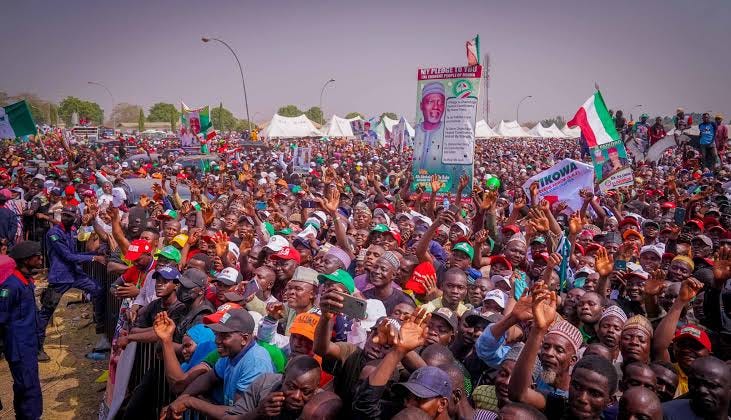
They told us all manner of lies to keep us waiting endlessly. At about 5 p.m., one of them emerged with word that the Personal Assistant (PA) to the gubernatorial candidate had asked us to leave, and that he would send information through the jobber who brokered the visit- a man described as the candidate’s younger brother. In Nigeria, your relationship with a big politician can make you a millionaire if you know your way around and can tell lies.
When we eventually got to the house, it became clear that this man was not the candidate’s younger brother. They were mere acquaintances, nothing more. The candidate’s house was modest; from the back it looked like a storey building, but from the front it looked like a bungalow. It was built to suit the undulating topography.
To the left of the house was what seemed like an observatory. It was fenced off from the main house, with a door leading into it. Three groups of supplicants- one Igbo, the others Yoruba- crowded around the gubernatorial candidate as he made for his huge SUV, obviously trying to escape them. Why? Simply because the candidate and his aides lack organizational skill.
The candidate shouted into the crowd: “Where is the ‘alaga’ that said he wants to see me?” The ‘alaga’ is the leader of our group. He is an Alfa. He thrust forward and made his request. He was then led inside the house to collect “feedback.” This “feedback” is also called “owo alejo” —in English, entertainment money or transport money. These are euphemisms for subtle bribes from the candidate in exchange for votes. As for our real request, we were told to see the Campaign Director-General, which seems a clever way of rejecting it.
The ‘alaga’ returned with a nylon bag, and what we had actually come for became inconsequential. We all moved out, and within earshot of the house, the scramble to know the contents of the bag began among the twelve supplicants and two political jobbers. The ‘alaga’ had been tutored beforehand to ask for the candidate’s campaign face caps as proof that our community would vote for him. Someone dipped his hand into the bag and brought out a pack of nine caps. That did not interest the group; the cash inside was of more interest.
A hand soon brought it out and counted it. It was N250,000. Immediately it was announced, I knew someone had committed fraud- possibly the PA. We had heard from groups who visited before us that the candidate gave N300,000 to each group. A cousin and another lady close to him had told me that was the standard amount.
They did the math and announced each person’s share. When mine was to be handed over, I rejected it. The ‘alaga’ asked for it and it was given to him. I announced again that since the ‘alaga’ had not included me in the list of those to squeeze into the car to go straight to the Campaign DG, I would be going home by public transport. I left and nobody said anything. For me, collecting “transport money” was immoral, since the community that sent us had taxed themselves N1,000 per household to pay for our movement. If we must collect that money, it should be returned to the community.
In the days preceding the visit, I had been told of a plan to inflate the estimate given to us by the DisCo from N2 million to N5 million so that the political jobbers could take their cut. I argued against it because I felt we did not need the jobbers and that they were lying to us. They told me that was how politics works in Nigeria. I threatened to expose them if they did it. Now I was face-to-face with that reality. They did it and could not be bothered if I went to hell.
That is the state of politics in Nigeria. One of the elders, who said he was 80 years old, told me bluntly that this is how politics is done here. He told me that a prominent politician who's the grandson of a very prominent First Republic politician from our community and a front-runner in the state gubernatorial contest lost the primaries because “he did not give monthly money to those of us who are old in the community.” He told me stories of organized rigging in the past. He was a ward leader in the PDP and a proud disciple of the late Lamidi Adedibu, often described in the media as the “stormy petrel of politics” in the sprawling city.
Another political jobber who followed us around said, almost subconsciously, as we walked back from the campaign office: “Elections are nothing but chicanery.” We had been discussing the candidate’s chances of winning the forthcoming election. The hidden meaning was that it was pointless to discuss winning; what mattered was whether they could rig it for him. I do not know the source or authenticity of his story, but he said President Tinubu had specially appointed the gubernatorial candidate as special ambassador to all nations where elections had been won and lost.
In his mind, that appointment was to teach the candidate the chicanery of elections. He is now well-informed, and the knowledge will be very useful in the coming polls. What he said warned me of what to expect in January as the elections approach.
Nigerian politicians spend a fortune to win or rig elections. If every visiting group goes home with N300,000; if two cows are slaughtered daily; if a large retinue of vehicles is deployed; if every hanger-on must skim money off the contestants; if they must travel to Mecca or Jerusalem to pray; if they must hire large facilities as campaign offices; if they must maintain a large retinue of aides, politicians must be spending a fortune.
Where do they get the money? I asked a politician close to the candidate. “The gubernatorial candidate is not rich,” he told me. “But when you are able to carry your load up to your chest, people will come to help you carry it to your head. Elections are a very big investment in Nigeria. Those who help you carry the load for the rest of the journey to your head are investing in your election, and they must reap when you eventually win.”
This candidate, said not to be rich, is rumoured to own houses in the big city. The Alfa who drove us in his rickety wagon claimed to know him. He said the candidate sold two houses to contest a senatorial election, which he won. But in his one term in the Senate, he built five houses. He was not deriding the candidate. Quoting from the Qur’an, he said the Holy Prophet justified him because “we must first live well on earth before we live well in heaven.” There is a rumour in the big city that the gubernatorial candidate collects $1.5 million every month through a federal source who heads a major financial office of the federation. In other words, it is taxpayers’ money that funds all the excesses of these politicians. The contest for office in Nigeria is a contest for looting the treasury. Politics has become the most profitable industry in the country.
Religion and the greed of Nigerians, both leaders and followers, have created fertile ground for corruption to thrive. Leaders do not bat an eyelid before stealing; they justify it with religious injunctions such as the one quoted by this Alfa. Followers do not bat an eyelid before stealing or scamming contestants because they too find justification in religion. Former President Goodluck Jonathan was seen in a video at the Wailing Wall in Israel, a monument the Jews themselves have largely abandoned as a place of worship. Jonathan went to pray to a wall to win an election. But he lost.
What then will deliver Nigeria? Our nation must be restructured. This country can never be run from one centre. The character of the politicians and that of “we the people” must also change. Who or what will bring about that change? A revolution, I suggest.
First Published in METRO
***********************
Tunde Akande is both a journalist and pastor. He earned a Master's degree in Mass Communication from the University of Lagos.


No comments:
Post a Comment